Geometry Slope
About Geometry Slope
Geometry Slope is a digital magazine where players discover and play games inspired by geometry, physics, motion, and creative learning ideas.
For many years, most gaming websites have been built in a similar way: publishing new games, posting guides, ranking trending titles, or chasing short-form entertainment content. There is nothing wrong with that, because games are ultimately created to entertain and help people relax. However, the deeper people look into modern games, the more they begin to realize that many memorable titles are built on ideas far more interesting than what appears on the surface. A well-designed map is not memorable only because of its visuals. A satisfying gameplay loop does not become engaging simply because it moves fast. And the feeling of smooth control often comes from something less visible: geometric structure, movement logic, spatial rhythm, and carefully calculated physics working silently behind the screen.
Geometry Slope was created from that perspective.
This is not simply a website that uploads games in large quantities. Geometry Slope is designed as a themed gaming magazine - a place dedicated to games connected to geometry, mathematics, physics, spatial design, and creative structure. Instead of only asking, "Is this game popular?", Geometry Slope wants to explore a deeper question: why does this gameplay feel so satisfying? Why can a few simple geometric shapes create such intense reflex pressure? Why do slopes, angles, and movement patterns pull players into the screen within seconds?
That is how Geometry Slope sees video games - not only as entertainment products, but as a combination of visual art, mathematics, and motion.
When Mathematics No Longer Lives Only on Paper
Many people associate mathematics with classrooms, formulas, and exams. Yet in modern games, mathematics appears everywhere in a far more visual and interactive form. A jump in a platform game is essentially a trajectory problem. A high-speed racing path depends on angles and acceleration. Even a 3D game camera operates through spatial geometry and visual perspective.
What makes this fascinating is that players often feel these systems without consciously recognizing them. When a map feels "smooth," players naturally move through it comfortably. When gameplay has good rhythm, reflexes begin working almost instinctively. Behind that natural feeling are layers of geometric and physical rules operating invisibly.
Geometry Slope is interested in that invisible layer.
The magazine does not approach games like a heavy academic lecture or try to turn gameplay into mathematics homework. Instead, Geometry Slope explores how mathematical principles are transformed into movement, level design, and visual experience inside modern games. Concepts once found on chalkboards and textbook pages now exist as neon lights, speed effects, and immersive 3D environments.
That is why Geometry Slope does not see mathematics and gaming as separate worlds. In reality, many of today's most engaging games are built upon the same core principles found in geometry and physics.
"Geometry" Means More Than Shapes
The word "Geometry" usually makes people think about triangles, squares, straight lines, and classroom exercises. But in video games, geometry carries a much broader meaning. It represents how space is organized, how players are guided through environments, and how gameplay functions through visual structure.
A strong game level is almost like architecture. The player's eyes are constantly guided in a certain direction. The spacing between obstacles creates rhythm. The shape of the map controls movement flow. Even neon lines running across the screen help direct focus and create a sense of speed.
Because of this, geometry inside games is no longer just "school geometry." It becomes a language of design. Some games use extremely simple shapes while still feeling modern and powerful, because geometry is carefully used to create visual rhythm and gameplay movement.
This explains why many arcade games and endless runners embrace:
- minimalistic forms
- neon aesthetics
- abstract environments
- strong geometric structure
These design choices make gameplay easier for the human brain to process. Players react faster because their eyes instantly recognize movement patterns and spatial structure.
Geometry Slope wants to explore that unique design language.
"Slope" Represents Continuous Motion Through Space
If "Geometry" represents structure, then "Slope" represents motion. In mathematics, slope describes the steepness of a line - the relationship between vertical and horizontal change.
Inside games, however, slope becomes more than a formula. It becomes a feeling.
A downward path increases speed. Angled movement changes reflex timing. Expanding space creates the sensation of constantly rushing forward. By simply adjusting the angle of a surface or the tilt of a camera, an entire gameplay experience can feel dramatically different.
That is why many fast-paced games create intense pressure even when their mechanics are relatively simple. Players are not reacting only to obstacles. They are reacting to steepness, spatial depth, acceleration, and the illusion of losing control created by motion.
Geometry Slope views "slope" as a symbol of continuous movement inside a geometric digital world. It represents the sensation of always moving forward - something that has become central to many modern arcade experiences.
The Geometry Slope Logo as a Visual Manifesto
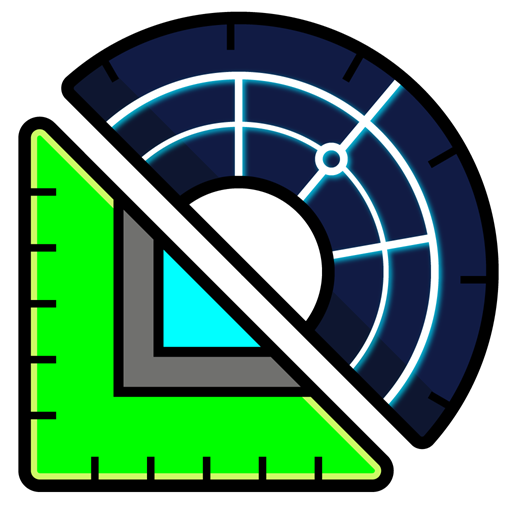
The combination of a square geometric ruler and a protractor
Many gaming brands use mascots or cartoon characters for recognition. Geometry Slope deliberately chose a different direction: building its identity from educational tools associated with mathematics and geometry.
The logo is constructed from two familiar objects:
- a geometric ruler set square
- a protractor
These are basic classroom tools, yet when combined with neon aesthetics and arcade-inspired design, they create a visual identity that feels both academic and futuristic.
The set square takes inspiration from the geometric visual language of:
Geometry Dash
Meanwhile, the protractor draws inspiration from:
Slope
However, the meaning of the logo goes beyond referencing famous games. More importantly, it reflects the philosophy of the magazine itself: transforming educational concepts into visual creativity and modern gameplay inspiration.
Inside the world of Geometry Slope, a ruler is no longer just a tool for drawing angles. It becomes a symbol of level structure, geometric motion, and game design thinking.
Geometry Slope Does Not Chase Everything - It Pursues a Perspective
The internet already contains countless gaming websites. But as content grows larger and faster, genuine identity becomes increasingly difficult to find. Many websites publish the same news, the same trailers, and the same trending topics.
Geometry Slope does not want to become another version of that.
The magazine is built around a very specific perspective: looking at games through the lens of structure, movement, and design philosophy. Because of that, the focus is not only on "what is new," but also on:
- why a gameplay system feels satisfying
- why players become absorbed in movement rhythm
- why minimalistic geometry feels futuristic
- and why mathematical ideas that once seemed dry can become the foundation of compelling entertainment
That is why Geometry Slope speaks to people who enjoy looking deeper into games beyond the surface level.
When the Classroom Becomes Inspiration for Modern Game Art
One of the most interesting things about gaming is how many familiar educational concepts quietly appear inside modern gameplay. Coordinate systems, graphs, vectors, slopes, trajectories, and spatial geometry are now common elements across countless games.
Even:
- chalkboards
- compasses
- rulers
- protractors
can become inspiration for user interfaces or artistic direction.
Geometry Slope wants to preserve that spirit - the spirit of transforming knowledge into visual creativity. Not by turning games into lessons, but by showing how education and entertainment have always been more connected than people realize.
Because sometimes, the objects that once sat on a classroom desk become the foundation for some of the most fascinating digital worlds ever created.
Geometry Slope offers a space for players to relax, explore unique games, and enjoy creative gaming moments during study breaks or free time throughout the day.